The cause underneath
Attic Ventilation Installation in Tomball, TX
Intake and exhaust airflow put right. Gulf Coast humidity in an under-ventilated attic cooks a roof from below, which is why some roofs age faster than their warranty.
What this actually is.
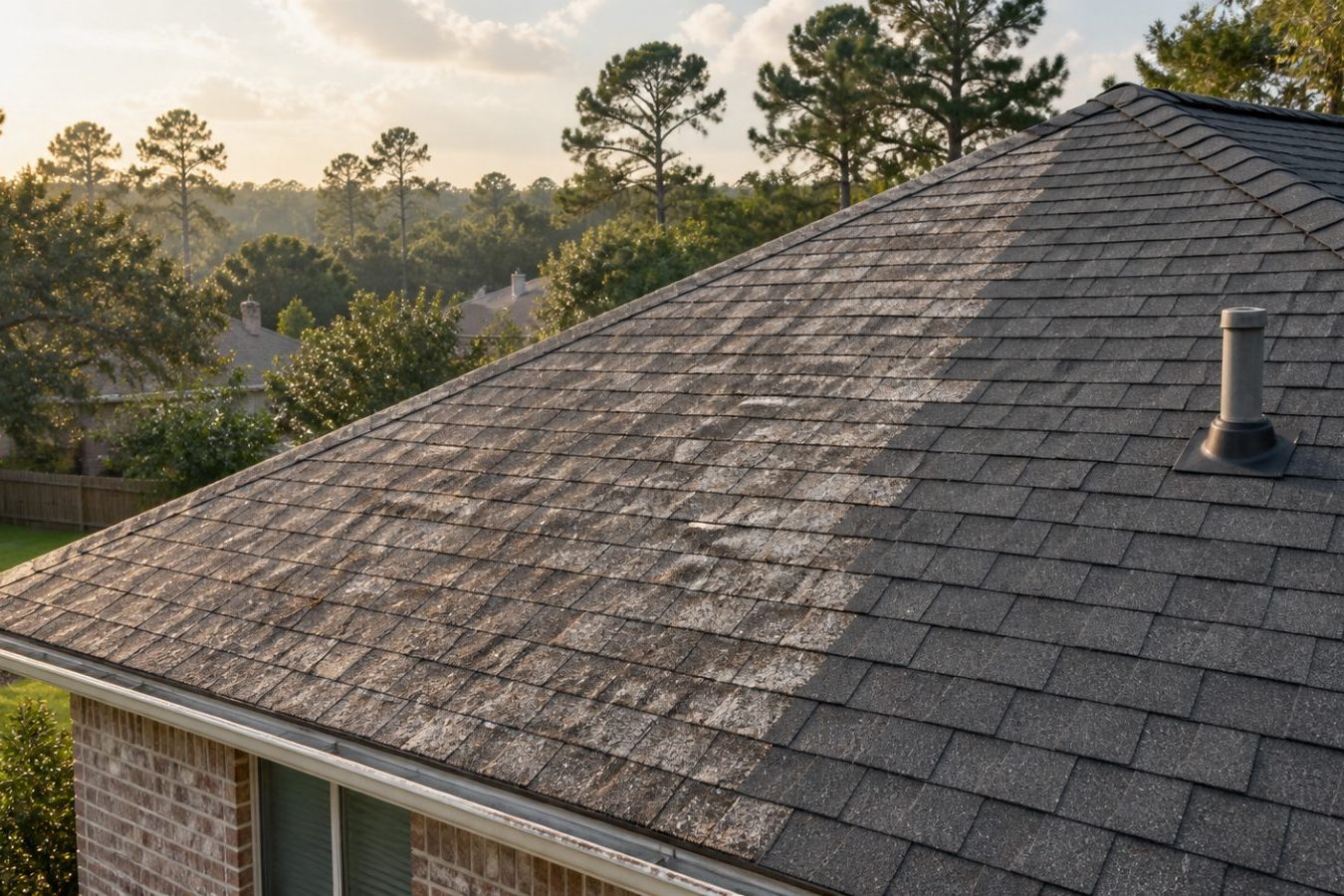
A Houston attic in August is the hottest space anyone owns. When that heat has nowhere to go it works on the roof from underneath — shingles age ahead of their rating, adhesive softens, and the moisture that should be leaving condenses on the decking instead. Most people find out about it after their second early roof, which is an expensive way to learn it.
We check whether the intake at the eaves is genuinely open rather than merely present, whether the exhaust is enough for the space, and whether two different exhaust types are quietly fighting each other on the same plane. Then we quote what it takes to balance it.
- An attic that is brutal even by Houston standards
- Upstairs rooms that will not hold a temperature
- Dark staining or condensation on the underside of the decking
- Shingles that failed well short of their rated life
- A musty smell, or visible mould growth, up in the attic
- Soffit vents buried behind blown-in insulation
- Two different kinds of vent on the same roof plane
How attic ventilation is actually supposed to work
The principle runs on physics and nothing else. Hot air rises. Give it a way out at the top of the attic and a way in at the bottom, and it leaves through the top while pulling cooler outside air in behind it at the eaves. The attic empties itself continuously, for free, with no moving parts and nothing to switch on.
The way in is the soffit, the underside of the roof overhang, where vents let air enter low. The way out sits at or near the ridge. Both halves have to exist. Exhaust with no intake has nothing to draw on, and intake with no exhaust has nowhere to send it.
This is why it is a roofing job rather than an HVAC one. It is built into the roof, most of it can only be reached from the roof, and it is the reason a great many roofs here fail years early.
Why more vents usually make attic ventilation worse
The instinct when an attic runs hot is to cut in another vent. It is usually the wrong move and it can actively make things worse.
Exhaust vents take their air from wherever it is easiest to get. Put two types on the same plane — a ridge vent and a powered fan, or a ridge vent and box vents — and the stronger one will often draw from the other rather than from the soffits. Air comes in one hole in the roof and straight back out another a few feet away, while the attic itself barely moves. In wind-driven rain, an exhaust vent being used as an intake is also a route for water.
So the answer to a hot attic is rarely more holes. It is one type of exhaust, and enough genuinely open intake at the eaves to feed it.
What an attic ventilation contractor should check first
In practice the failure is nearly always at the intake end, and nearly always for the same reason. At some point the attic was insulated, the material was blown in toward the edges, and it buried the soffit vents. From the ground the vents are still there. Behind them there is no path for air at all.
Baffles are the fix — rigid channels stapled between the rafters at the eave that hold insulation back and keep an open run from the soffit into the attic. They cost very little and they are missing far more often than they are present.
The other version is soffit vents painted shut, or a soffit replaced at some point with a solid panel and never re-vented. If you are having soffit and fascia work done, that is the moment to put the intake back in, because everything is already open and reachable.
What moves the price.
We do not price a roof we have not been on. These are the things that actually move the number once we have.
What has to be cut
Adding ridge exhaust means cutting a slot the length of the ridge and reworking the cap. Adding intake may mean cutting new soffit vents. Both are labour before they are materials.
Whether insulation has to be moved
If blown-in insulation has buried the eaves, someone has to work along the edge of the attic in the hottest, tightest part of the space, install baffles and pull the material back. That is slow work and it prices accordingly.
Roof size and how many planes
A balanced system has to work on each plane independently, so a house with several separate roof sections is several systems rather than one.
Whether it is done with a re-roof
Substantially cheaper as part of a re-roof, because the roof is already open and the ridge is already off. Doing it later means paying to reach what was briefly free to reach.
What to ask before you hire anyone.
Texas does not license roofing contractors, so the checks nobody did for you are the checks you make yourself. Four that are worth the awkwardness.
- Is my intake genuinely open, or just visible from the ground?
Present and open are different things, and the gap between them is usually a layer of blown-in insulation nobody has looked behind. - Are we running two exhaust types on the same plane?
Mixed exhaust on one plane is the most common way a ventilation upgrade makes the attic worse instead of better. It is worth asking before the work, not after. - Does my shingle warranty specify a ventilation ratio?
Several manufacturer warranties void outright if the attic does not meet a stated ratio. If your roof is young enough to still be covered, that clause decides the specification. - Do I need baffles, and are they inside this price?
Baffles are cheap, frequently missing, and the single most likely reason your intake does not work. A ventilation quote without them is often a quote for exhaust only.
What happens after you call.
Tell us what you can see
A ring on the hall ceiling, grit in the gutters, shingles in the yard after a storm. Describe the symptom. Working out the cause is our job, not yours.
We get on the roof and trace it
Roof plane, valleys, every penetration, then the attic side with a light. Water runs along decking before it drops, so the entry point is almost never above the stain.
You get the finding and the price
What failed, what it takes to put right, what can safely wait until next year. Written down, in words that need no decoding, before anyone quotes you anything.
We do the work we quoted
Scoped to what we found rather than to what we could sell. Under Tomball's 2021 residential code, past 25 percent of the covering the choice stops being ours anyway.
Attic Ventilation Installation — what people ask.
Do more vents always help?
No, and this is the most common mistake in the trade. Two exhaust types on one plane means the stronger draws from the weaker instead of from the eaves, so you have added a hole and moved less air than before.
Is this really a roofing job?
Yes. It is built into the roof, most of it is only reachable from the roof, and it is one of the main reasons roofs here fail early. An HVAC contractor can cool the house; only a roofer can fix why the attic is cooking the shingles.
Will it lower my cooling bill?
Sometimes, and it is not the reason to do it. The reason is the roof — an attic running at extreme temperatures ages the covering from underneath and can void the manufacturer warranty outright. Treat any cooling saving as a bonus rather than the business case.
What about a powered attic fan?
They move air, and in an attic with poor intake they can pull conditioned air out of the house through ceiling gaps, which costs you money to run and money to cool. Fix the intake first. If the passive system is balanced, most Tomball attics do not need a fan at all.
Is a hot attic actually a problem, or just uncomfortable?
It is a roof problem. Sustained heat softens the adhesive, drives off volatiles in the asphalt and brings the shingles to the end of their life early. Uncomfortable is what you notice; a roof replaced five years ahead of schedule is what it costs.
How do I know if it is bad enough to fix?
Look at the underside of the decking. Dark staining, rust on the nail points, or condensation means moisture is not leaving. Combine that with soffit vents you cannot see daylight through and you have the answer without needing a measurement.
Can I check the soffit vents myself?
Partly, and it is worth doing. From the ground you can see whether vents exist. From inside the attic, at the very edge, you can see whether insulation has buried them — that is the half that matters and the half nobody looks at. Mind your footing on the joists.
How many years do roofs last in Texas?
Published figures put asphalt shingle roofs in the Houston area at roughly 15 to 25 years, builder-grade three-tab at the bottom of that and architectural higher. Two things pull it in here. Heat, which softens and oxidises the asphalt binder in direct sun and cooks the same shingle from underneath when the attic does not vent. And hail, where one serious storm can take years off whatever was left, often without leaving damage you can see from the ground.
Other roofing work we do.
Need attic ventilation installation in Tomball?
Free written estimate, no obligation. Call or send the form.
Free · No obligation · Insured