Jumps the queue
Emergency Roof Repair in Tomball, TX
Water coming in now, decking open to the sky, a tarp needed before the next band of rain. These go ahead of scheduled work.
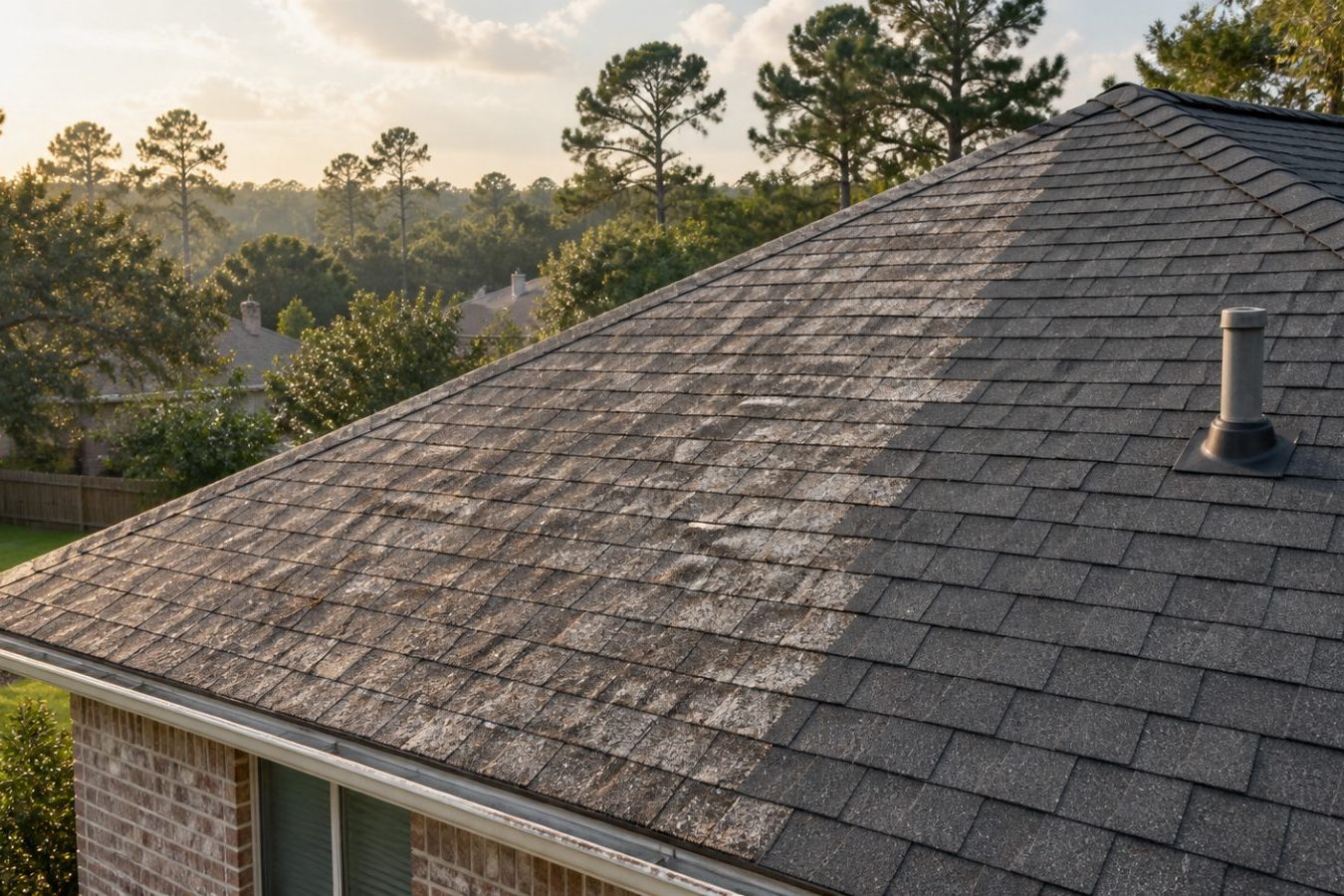
What this actually is.
An emergency is not decided by how bad the roof looks from the driveway. It is decided by whether water is inside the house right now. A fist-sized hole over a detached garage can wait for a dry morning. A steady drip through a bedroom ceiling cannot, because at that point the damage has stopped being roofing and started being drywall, insulation, wiring and framing.
These jump ahead of scheduled work. The first job is to stop water entering the building — usually a mechanically fastened tarp, or a temporary dry-in where the covering has gone entirely. The permanent repair gets assessed and quoted separately, once the roof is dry enough to read properly.
- Water running or dripping indoors while it is still raining
- A ceiling that is sagging, bulging or bubbling downward
- Decking or underlayment open to the sky
- A limb or debris sitting on the roof after a blow
- Shingles stripped off in sheets rather than singly
- Water showing up near a light fitting, fan or outlet
- A tarp already on and starting to lift at the edges
Emergency roof repair starts inside the house, not on the roof
Deal with the room before you think about the roof. Move furniture and electronics out from under the leak, get a container down, lift rugs. A soaked ceiling holds more water than people expect and it keeps arriving for a while after the rain has stopped.
A ceiling that is bulging is holding a pocket of water, and left alone it lets go all at once across a wide area. Putting a small hole at the lowest point of the bulge drains it into a bucket you placed deliberately, which is a much better outcome than the whole section coming down. Stand to the side of it, not under it.
If water is anywhere near a light fitting, a ceiling fan or an outlet, it is an electrical problem as well as a roofing one. Kill that circuit at the breaker and leave it off. Do not go up into the attic with a light while there is standing water on the ceiling below.
And stay off the roof. A wet roof, in the dark, in wind, is how people get badly hurt, and there is nothing you can do up there that is not done more safely in daylight by someone with a harness.
Photograph the storm damage before anyone touches the roof
This is the step people skip and regret. Before a tarp goes on and before anything is tidied, photograph it from every angle you can reach safely — the ceiling, the wet insulation, the ruined contents, and the outside of the house from ground level. Take far more than feels necessary and leave the timestamps alone.
If a claim follows, that set of photographs is what separates what the storm did from what was already worn out. It also protects you when the temporary work changes how the damage looks, which it always does.
Keep receipts for anything you buy to limit the damage, and keep the emergency invoice separate from the permanent repair invoice. We are not insurance advisers and we do not handle claims, but keeping those two apart is ordinary practice and costs you nothing.
Roof tarping first, permanent repair second
Turning up to an active leak is not a repair visit. The job that night is to stop water getting into the building: a tarp fastened down properly, or a temporary dry-in across a plane that has lost its covering.
That order is not a way of generating two invoices. A permanent repair needs a dry surface and a proper look at what failed, and neither exists in the rain. Real repairs attempted on a soaked roof come apart, and then you have paid for the same thing twice.
What you should get is a plain statement of what was done as a temporary measure, roughly how long it will hold, and a booked visit to assess and quote the permanent work. If that quote turns out to be a full replacement rather than a repair, that is a decision for a dry afternoon, not for ten o'clock at night with a bucket in the hall.
What moves the price.
We do not price a roof we have not been on. These are the things that actually move the number once we have.
Temporary versus permanent
Emergency work bills as its own job — a crew out at short notice to stop water, separate from the permanent repair quoted later. Two invoices is the correct shape here, not an upsell.
When you call
Nights, weekends and the middle of a storm cost more than a booked visit, here and everywhere. Worth knowing before you call rather than after.
How much roof is open
Tarping one damaged area is a different job from drying in a plane that has lost its covering. The measure is how much roof is open to the sky, not how bad the leak looks indoors.
What the water has already reached
If insulation, drywall or flooring are already wet there is work beyond roofing to be done, sometimes by other trades. That is not in a roofing quote and should not be presented as if it were.
What to ask before you hire anyone.
Texas does not license roofing contractors, so the checks nobody did for you are the checks you make yourself. Four that are worth the awkwardness.
- Is what you are doing today temporary or permanent?
You want to hear the word temporary out loud, with roughly how long it holds. A tarp described as a fix is the beginning of an argument later. - What will the permanent repair involve, and when can you assess it?
Get the follow-up booked while someone is standing there. Storm weeks fill up fast, and a tarp with no appointment behind it tends to become the roof. - Are you documenting this for my insurer?
Photographs and a written note of what was found, before the tarp changes how it looks. Your insurer decides the claim; the documentation is what they decide it on. - Can I see your current insurance certificate?
Texas licenses no roofing contractors, so insurance is the only credential you can actually verify — and it matters most on the night, when someone is on a wet roof at your property.
What happens after you call.
Tell us what you can see
A ring on the hall ceiling, grit in the gutters, shingles in the yard after a storm. Describe the symptom. Working out the cause is our job, not yours.
We get on the roof and trace it
Roof plane, valleys, every penetration, then the attic side with a light. Water runs along decking before it drops, so the entry point is almost never above the stain.
You get the finding and the price
What failed, what it takes to put right, what can safely wait until next year. Written down, in words that need no decoding, before anyone quotes you anything.
We do the work we quoted
Scoped to what we found rather than to what we could sell. Under Tomball's 2021 residential code, past 25 percent of the covering the choice stops being ours anyway.
Emergency Roof Repair — what people ask.
What should I do before anyone arrives?
Protect the room, not the roof. Move what can be moved, get a container under the drip, and kill the breaker for any circuit near the water. Photograph everything first. Then stay off the roof and wait.
Do you do the emergency work yourselves?
Yes. Our own crews tarp it and come back to do the permanent repair. You are not being passed to somebody else in between.
Is this worth an insurance claim?
Often, for sudden storm or wind damage. Photograph before any repair, temporary work included, and speak to your carrier early. We document what we find and give you a written estimate; we are not qualified to advise on your policy and we do not file claims.
What actually counts as an emergency?
Water entering the house now, decking open to the sky, a ceiling sagging under a pocket of water, or anything wet near electrics. Missing shingles with a dry interior is urgent but it is not tonight.
It is the middle of the night. Should I wait until morning?
If water is coming in, call. If it is not, morning is safer and cheaper for both of us. Nobody does good work on a wet roof by torchlight, and the tarp that goes on at 2am is the same tarp that goes on at 8am.
Can I tarp it myself?
We would rather you did not. A tarp that is weighted rather than fastened lifts in the next gust and can take shingles with it, and every year people are hurt falling off wet roofs doing exactly this. If it is unavoidable, do it from a ladder at the edge, never from up on the plane.
Someone knocked on my door after the storm. Should I use them?
Be careful and take your time. Door-knocking after a storm is common and not all of it is dishonest, but it is where most complaints start. Do not sign on the doorstep, do not pay a large deposit up front, and check the insurance yourself. Texas does not license roofers, so nobody has vetted them for you.
How can I afford an emergency roof repair?
Deal with the water first and the money second — an active leak gets more expensive every hour it runs. If it is storm damage, the policy is the first place to look. The temporary work and the permanent repair can be separated on the invoice, which spreads it, and financing exists if you ask for the terms rather than the monthly figure.
Other roofing work we do.
Need emergency roof repair in Tomball?
Free written estimate, no obligation. Call or send the form.
Free · No obligation · Insured